














Two figures answer different questions
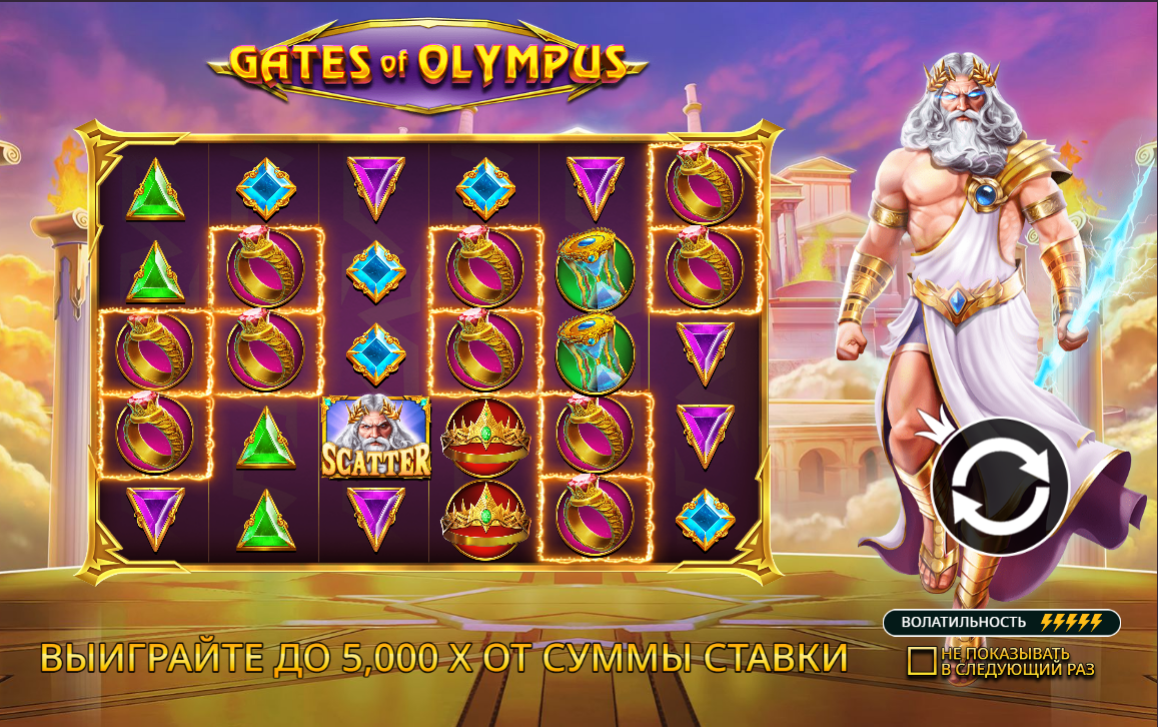
In the Gates of Olympus description, the 500x multiplier appears alongside the 5000x maximum win. In the 1000 version, the coefficient goes up to 1000x and the limit is 15,000x. These values cannot be used as synonyms.
The multiplier shows how many times a specific base payout can be boosted. The maximum win sets the upper limit of the result, after which the game stops any further payouts under the round rules.
How the multiplier combines with the base payout
First, 8–30 matching symbols create a win. Then the multipliers that appear on that cascade are added together and applied to the original sum. If the group produced a 2x stake win and Zeus added 25x and 75x, the total multiplier would be 100x, and the final stage result would be 200x.
That is why a 500x symbol does not mean an automatic 500x win. It can boost a small or large base payout, but only if there is a winning group. Without one, the multiplier does not trigger.
Limits of five versions
| Game | Top regular multiplier | Maximum win |
|---|---|---|
| Gates of Olympus | 500x | 5000x |
| Gates of Olympus 1000 | 1000x | 15,000x |
| Xmas 1000 | 1000x | 15,000x |
| Super Scatter | 500x | 50,000x |
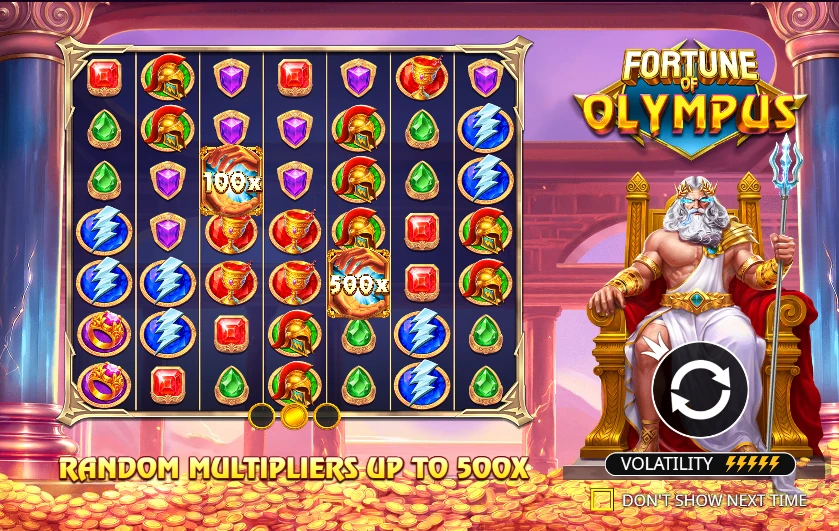
| Fortune of Olympus | 500x | 10,000x |
The table shows that the highest regular multiplier and the highest limit belong to different versions. Super Scatter is capped at multipliers of up to 500x, but its special symbol can deliver a fixed prize of up to 50,000x when the bonus starts.
Why the 1000 version does not have a 1000x maximum
In Gates of Olympus 1000, multipliers can stack. In addition, they are applied to the base value of the group, and during free spins they add to the overall counter. The final result is made up of several elements, so the maximum win is set separately at 15,000x.
The name "1000" describes the main expansion of the range, not the limit of the entire game.
Why Super Scatter reaches 50,000x with multipliers up to 500x
In Super Scatter, the top prize is tied to four special Scatter symbols landing together with bonus activation. It is a fixed prize, not the result of multiplying a cluster with a winged orb.
That is why the comparison "1000x is bigger than 500x, so the 1000 version must have the higher maximum" is incorrect. The mechanism for reaching the limit is different.
What the maximum number does not tell you
It does not show the probability, the average result, the bonus frequency, or the length of losing streaks. The maximum is a technical ceiling. Two games with the same cap can distribute payouts in completely different ways.
To evaluate the mechanics, it is more useful to look at RTP, volatility, the way groups are formed, the bonus trigger, and the rules for multiplier accumulation together. None of these characteristics turns the maximum win into a forecast.
How to read these numbers during a demo session
A useful demo check is to separate three events on each spin: the size of the symbol group, the multipliers that land with that group, and the running cap of the version you are testing. This prevents a misleading impression when a large orb appears on an empty grid or when several smaller multipliers create a stronger result than one headline number.
For the original game, watch how often the multiplier actually connects with an 8+ symbol group. For the 1000 and Xmas 1000 versions, pay attention to the accumulated counter in free spins. For Super Scatter, keep the special Scatter prize separate from ordinary orb multipliers. The comparison becomes clearer when each version is judged by the mechanic that can actually reach its limit.
Conclusion
The maximum multiplier boosts a specific payout; the maximum win caps the result of the game as a whole. In the Olympus series, these figures are intentionally different: 500x/5000x in the original, 1000x/15,000x in the 1000 version, and 500x/50,000x in Super Scatter. Understanding the difference helps avoid the most common mistake when comparing versions.